Bluestriped Grunt
Haemulon sciurus
How to tell it
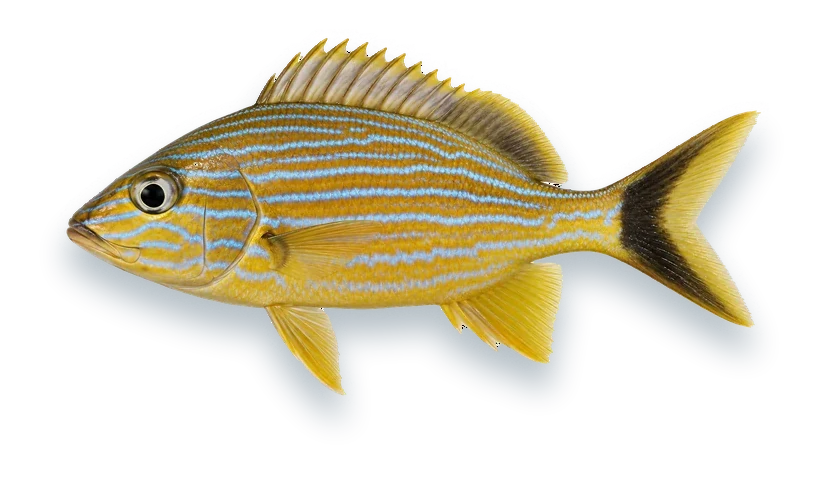
Yellow body covered nose-to-tail in electric-blue stripes; dusky tail and rear dorsal.
Often mistaken for
Two fish that get called bluestriped grunt, and what gives each one away.
- French grunt: Stripes slant below the midline. Tell them apart
- Porkfish: Two black face bars. Tell them apart
Rules for
Every state
| State | Size | Bag | Season | Today |
|---|---|---|---|---|
| Florida (Atlantic) | No size limit | 2 fish or 100 lb per person per day, whichever is greater | Open year-roundFWC 2026 · checked | Open |
Not specifically regulated in Alabama, Connecticut, Delaware, Florida (Gulf), Georgia, Louisiana, Maine, Maryland, Massachusetts, Mississippi, New Hampshire, New Jersey, New York, North Carolina, Rhode Island, South Carolina, Texas, Virginia: each state’s rule for unlisted species applies there (on its page).
On the table
Fine panfish — the original grits-and-grunts fish.
In the app
Point the camera at a bluestriped grunt and the name appears before you take the picture, with these rules for the water you’re standing in. No signal needed, and every catch goes in the log.
Get the appQuestions anglers ask about bluestriped grunt
How many bluestriped grunt can you keep?
Florida (Atlantic): 2 fish or 100 lb per person per day, whichever is greater.
How do you tell bluestriped grunt from french grunt?
Bluestriped Grunt: Yellow body covered nose-to-tail in electric-blue stripes; dusky tail and rear dorsal. French grunt: stripes slant below the midline.