Ocean PoutorAmerican Eel
Two fish anglers mix up. Here is what separates them, and what each one’s rules are in your state.
How to tell them apart
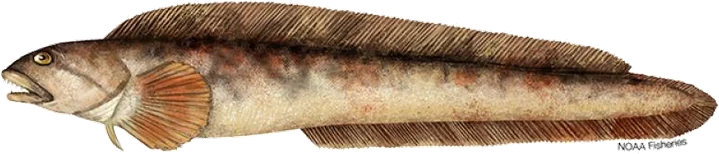
Ocean Pout
Eel-shaped body with a frog face and fleshy lips; single long dorsal running to the tail.
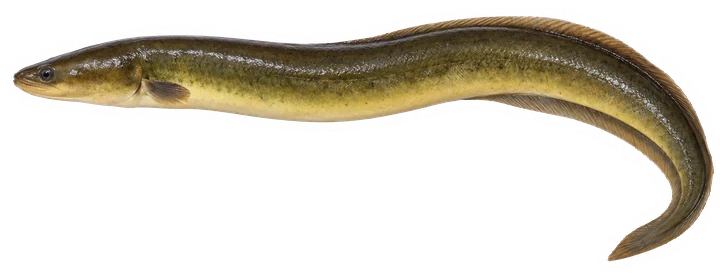
American Eel
A true eel — one continuous fin running from mid-back around the tail; lower jaw juts past the upper.
American eel, next to ocean pout: true eel, continuous fin.
Side by side
| Ocean Pout | American Eel | |
|---|---|---|
| Scientific name | Zoarces americanus | Anguilla rostrata |
| Also called | — | Yellow eel, Silver eel |
| Waters | Inshore | Inshore |
| Heaviest state record | — | 9 lb 13 oz · New Jersey (1988) |
| On the table | Not kept — release. | Rich — excellent smoked. |
| Rules of its own in | 5 states | 15 states |
Rules for
Every state, both fish
The two fish are regulated differently in 15 of 15 states with a rule for either. In Connecticut, ocean pout is —, No retention and American eel is 9" minimum, 25 per angler. Call the fish wrong and you keep a short one or throw back a legal one.
| State | Ocean Pout: size · bag · season | American Eel: size · bag · season |
|---|---|---|
| Connecticut | —No retentionProhibitedPut it backFederal rule (New England federal waters)NOAA GARFO 2026 · checked | 9" minimum25 per anglerOpen year-roundOpenCT DEEP 2026 · checked |
| Delaware | Not specifically regulated; the state’s default for unlisted species applies. | 9 in min25 per dayOpen year-roundOpenDE DNREC 2026 · checked |
| Florida (Atlantic) | Not specifically regulated; the state’s default for unlisted species applies. | 9 in TL min25 per dayOpen year-roundOpenFWC 2026 · likely · checked |
| Florida (Gulf) | Not specifically regulated; the state’s default for unlisted species applies. | 9 in TL min25 per dayOpen year-roundOpenFWC 2026 · likely · checked |
| Georgia | Not specifically regulated; the state’s default for unlisted species applies. | 9 in total length25 per person per dayOpen year-roundOpenGA DNR CRD 2026 · checked |
| Maine | —No retentionProhibitedPut it backFederal rule (New England federal waters)NOAA GARFO 2026 · checked | 9" min25 per dayOpen year-roundOpenME DMR 2026 · checked |
| Maryland | Not specifically regulated; the state’s default for unlisted species applies. | 9 in min25Jan 1-Aug 31 (hook and line); year-round for spears/trapsClosedMD DNR 2026 · checked |
| Massachusetts | —No retentionProhibitedPut it backFederal rule (New England federal waters)NOAA GARFO 2026 · checked | 9" min25 fish (50 on for-hire vessels)Open year-roundOpenMA DMF 2026 · checked |
| New Hampshire | Possession prohibitedPossession prohibitedClosed year-roundPut it backNH F&G 2026 · checked | 9 in TL min25 fish/dayOpen year-roundOpenNH F&G 2026 · checked |
| New Jersey | Not specifically regulated; the state’s default for unlisted species applies. | 9 in min25Open year-roundOpenNJ DEP 2026 · checked |
| New York | Not specifically regulated; the state’s default for unlisted species applies. | 9"25 (50 on party/charter)Open year-roundOpenNY DEC 2026 · checked |
| North Carolina | Not specifically regulated; the state’s default for unlisted species applies. | 9 in total length25 per dayJan 1 – Aug 31ClosedNC DMF 2026 · checked |
| Rhode Island | —No retentionProhibitedPut it backFederal rule (New England federal waters)NOAA GARFO 2026 · checked | 9" min25/person/day (50/vessel on licensed party/charter)Open year-roundOpenRI DEM 2026 · checked |
| South Carolina | Not specifically regulated; the state’s default for unlisted species applies. | 9 in minimum25/dayOpen year-roundOpenSC DNR 2026 · checked |
| Virginia | Not specifically regulated; the state’s default for unlisted species applies. | 9 in min25 per personOpen year-roundOpenVMRC 2026 · checked |
In the app
Point the camera at the fish and Chum names it before you take the picture, ocean pout or American eel, with the right rules for the water you’re standing in. No signal needed.
Get the appQuestions anglers ask
How do you tell ocean pout from American eel?
Ocean Pout: Eel-shaped body with a frog face and fleshy lips; single long dorsal running to the tail. American Eel: A true eel — one continuous fin running from mid-back around the tail; lower jaw juts past the upper. American eel, next to ocean pout: true eel, continuous fin.
Which is better to eat, ocean pout or American eel?
Ocean Pout: Not kept — release. American Eel: Rich — excellent smoked.
Do ocean pout and American eel have the same limits?
Not everywhere. They differ in 15 state rulebooks. Connecticut: ocean pout —, No retention, American eel 9" minimum, 25 per angler; Maine: ocean pout —, No retention, American eel 9" min, 25 per day; Massachusetts: ocean pout —, No retention, American eel 9" min, 25 fish (50 on for-hire vessels); New Hampshire: ocean pout Possession prohibited, Possession prohibited, American eel 9 in TL min, 25 fish/day; Rhode Island: ocean pout —, No retention, American eel 9" min, 25/person/day (50/vessel on licensed party/charter); and more in the table on this page.