Spanish MackerelorFalse Albacore
Two fish anglers mix up. Here is what separates them, and what each one’s rules are in your state.
How to tell them apart
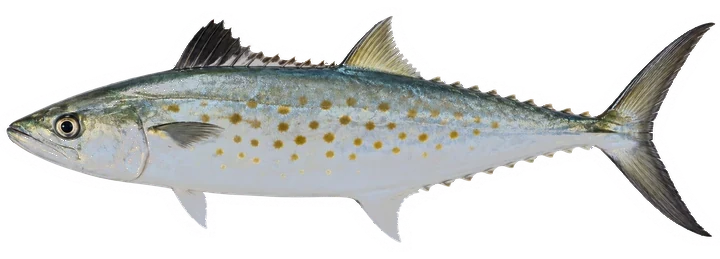
Spanish Mackerel
Gold-bronze spots on the flanks, no lateral-line dip, black front dorsal patch; smaller than a king.
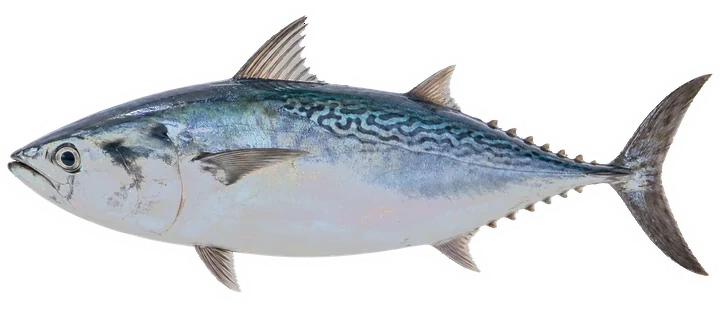
False Albacore
Wavy, worm-like markings above the lateral line only; spotless silver below; football body.
False albacore, next to Spanish mackerel: wavy worm-lines on the back, no spots.
Side by side
| Spanish Mackerel | False Albacore | |
|---|---|---|
| Scientific name | Scomberomorus maculatus | Euthynnus alletteratus |
| Also called | Spanish | Albie, Little tunny, Fat Albert |
| Waters | Nearshore | Offshore |
| Heaviest state record | 13 lb · North Carolina (1987) | 32 lb · North Carolina (2015) |
| On the table | Very good fresh or smoked; oily, doesn't keep long. | Poor — dark, strong-flavored; almost always released. |
| Rules of its own in | 14 states | 1 states |
Rules for
Every state, both fish
The two fish are regulated differently in 15 of 15 states with a rule for either. In Alabama, Spanish mackerel is No size limit, 15 per person while false albacore has no rule of its own there. Call the fish wrong and you keep a short one or throw back a legal one.
| State | Spanish Mackerel: size · bag · season | False Albacore: size · bag · season |
|---|---|---|
| Alabama | No size limit15 per personOpen year-roundOpenAL MRD 2026 · checked | Not specifically regulated; the state’s default for unlisted species applies. |
| Delaware | 14 in min15 per dayOpen year-roundOpenDE DNREC 2026 · checked | Not specifically regulated; the state’s default for unlisted species applies. |
| Florida (Atlantic) | 12 in fork length min15 per personOpen year-roundOpenFWC 2026 · checked | Not specifically regulated; the state’s default for unlisted species applies. |
| Florida (Gulf) | 12 in fork length min15 per personOpen year-roundOpenFWC 2026 · checked | Not specifically regulated; the state’s default for unlisted species applies. |
| Georgia | 12 in fork length15 per person per dayOpen year-roundOpenGA DNR CRD 2026 · checked | Not specifically regulated; the state’s default for unlisted species applies. |
| Louisiana | 12 in fork length15 per personOpen year-roundOpenLDWF 2026 · checked | Not specifically regulated; the state’s default for unlisted species applies. |
| Maryland | 14 in min15Open year-roundOpenMD DNR 2026 · checked | Not specifically regulated; the state’s default for unlisted species applies. |
| Massachusetts | Not specifically regulated; the state’s default for unlisted species applies. | 16" min (curved fork length)5 fish combined with Atlantic bonitoOpen year-roundOpenMA DMF 2026 · checked |
| Mississippi | 12 in fork length minimum15 per person per dayOpen year-roundOpenMS DMR 2026 · checked | Not specifically regulated; the state’s default for unlisted species applies. |
| New Jersey | 14 in min10Open year-roundOpenNJ DEP 2026 · checked | Not specifically regulated; the state’s default for unlisted species applies. |
| New York | 14"15Open year-roundOpenNY DEC 2026 · checked | Not specifically regulated; the state’s default for unlisted species applies. |
| North Carolina | 12" FL min15 per person per dayYear-roundOpenNC DMF 2026 · checked | Not specifically regulated; the state’s default for unlisted species applies. |
| South Carolina | 12 in fork length15/dayOpen year-roundOpenSC DNR 2026 · checked | Not specifically regulated; the state’s default for unlisted species applies. |
| Texas | 14 in total length15Open year-roundOpenTPWD 2026 · checked | Not specifically regulated; the state’s default for unlisted species applies. |
| Virginia | 14 in min15 per personOpen year-roundOpenVMRC 2026 · checked | Not specifically regulated; the state’s default for unlisted species applies. |
In the app
Point the camera at the fish and Chum names it before you take the picture, Spanish mackerel or false albacore, with the right rules for the water you’re standing in. No signal needed.
Get the appQuestions anglers ask
How do you tell Spanish mackerel from false albacore?
Spanish Mackerel: Gold-bronze spots on the flanks, no lateral-line dip, black front dorsal patch; smaller than a king. False Albacore: Wavy, worm-like markings above the lateral line only; spotless silver below; football body. False albacore, next to Spanish mackerel: wavy worm-lines on the back, no spots.
Which gets bigger, Spanish mackerel or false albacore?
False Albacore. The heaviest state record we hold is 32 lb in North Carolina; the heaviest Spanish mackerel record is 13 lb in North Carolina.
Which is better to eat, Spanish mackerel or false albacore?
Spanish Mackerel: Very good fresh or smoked; oily, doesn't keep long. False Albacore: Poor — dark, strong-flavored; almost always released.
Do Spanish mackerel and false albacore have the same limits?
Not everywhere. They differ in 15 state rulebooks. Alabama: Spanish mackerel No size limit, 15 per person, false albacore no rule of its own; Delaware: Spanish mackerel 14 in min, 15 per day, false albacore no rule of its own; Florida (Atlantic): Spanish mackerel 12 in fork length min, 15 per person, false albacore no rule of its own; Florida (Gulf): Spanish mackerel 12 in fork length min, 15 per person, false albacore no rule of its own; Georgia: Spanish mackerel 12 in fork length, 15 per person per day, false albacore no rule of its own; and more in the table on this page.