Caribbean Reef SharkorSandbar Shark
Two fish anglers mix up. Here is what separates them, and what each one’s rules are in your state.
How to tell them apart
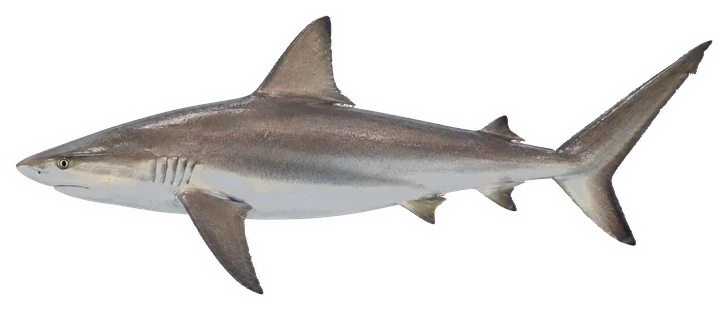
Caribbean Reef Shark
Bulky gray reef shark with a short blunt snout and dusky (not black-tipped) fin undersides — the default shark on Keys reefs.
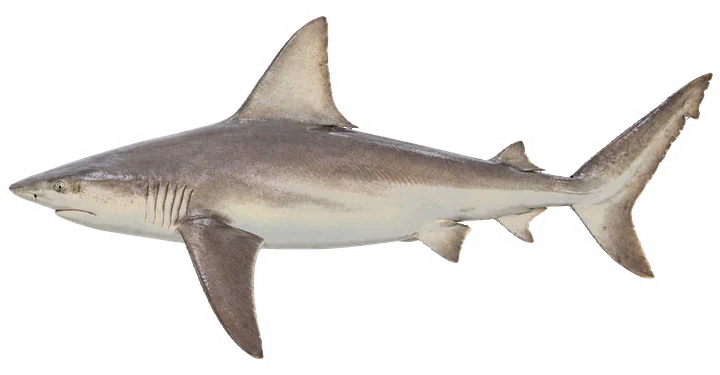
Sandbar Shark
Very tall first dorsal starting over the pectorals; high back ridge; stocky gray-brown body.
Sandbar shark, next to Caribbean reef shark: much taller first dorsal.
Side by side
| Caribbean Reef Shark | Sandbar Shark | |
|---|---|---|
| Scientific name | Carcharhinus perezii | Carcharhinus plumbeus |
| Also called | — | — |
| Waters | Sharks | Sharks |
| Heaviest state record | — | 235 lb · Maryland (1983) |
| On the table | Prohibited in Florida — release. | Prohibited for recreational harvest — release. |
| Rules of its own in | 17 states | 19 states |
Rules for
Every state, both fish
The two fish are regulated differently in 2 of 19 states with a rule for either. In New Hampshire, sandbar shark is N/A, No harvest or possession while Caribbean reef shark has no rule of its own there. Call the fish wrong and you keep a short one or throw back a legal one.
| State | Caribbean Reef Shark: size · bag · season | Sandbar Shark: size · bag · season |
|---|---|---|
| Alabama | Harvest prohibitedZeroClosed year-roundPut it backAL MRD 2026 · checked | Harvest prohibitedZeroClosed year-roundPut it backAL MRD 2026 · checked |
| Connecticut | Take prohibited0Closed year-roundPut it backCT DEEP 2026 · checked | Take prohibited0Closed year-roundPut it backCT DEEP 2026 · checked |
| Delaware | Harvest prohibited0No harvest permittedPut it backDE DNREC 2026 · checked | Harvest prohibited0No harvest permittedPut it backDE DNREC 2026 · checked |
| Florida (Atlantic) | No harvestNo harvestClosed year-roundPut it backFWC 2026 · checked | No harvestNo harvestClosed year-roundPut it backFWC 2026 · checked |
| Florida (Gulf) | No harvestNo harvestClosed year-roundPut it backFWC 2026 · checked | No harvestNo harvestClosed year-roundPut it backFWC 2026 · checked |
| Georgia | No harvestNo harvestClosed year-roundPut it backGA DNR CRD 2026 · checked | No harvestNo harvestClosed year-roundPut it backGA DNR CRD 2026 · checked |
| Louisiana | No harvestNo harvest or possessionClosed year-roundPut it backLDWF 2026 · checked | No harvestNo harvest or possessionClosed year-roundPut it backLDWF 2026 · checked |
| Maine | Take prohibitedNo harvest or possessionClosed year-roundPut it backME DMR 2026 · checked | Take prohibitedNo harvest or possessionClosed year-roundPut it backME DMR 2026 · checked |
| Maryland | No take0ClosedPut it backMD DNR 2026 · checked | No take0ClosedPut it backMD DNR 2026 · checked |
| Massachusetts | N/ANo possessionClosed year-roundPut it backMA DMF 2026 · checked | N/ANo possessionClosed year-roundPut it backMA DMF 2026 · checked |
| Mississippi | No takeNo takeClosed year-roundPut it backMS DMR 2026 · checked | No takeNo takeClosed year-roundPut it backMS DMR 2026 · checked |
| New Hampshire | Not specifically regulated; the state’s default for unlisted species applies. | N/ANo harvest or possessionClosed year-roundPut it backFederal rule (NOAA Highly Migratory Species)NOAA HMS 2026 · checked |
| New Jersey | Prohibited0No open seasonPut it backNJ DEP 2026 · checked | Prohibited0No open seasonPut it backNJ DEP 2026 · checked |
| New York | No possession0Closed all yearPut it backNY DEC 2026 · checked | No possession0Closed all yearPut it backNY DEC 2026 · checked |
| North Carolina | Not specifically regulated; the state’s default for unlisted species applies. | N/ANo harvest or possessionClosed year-roundPut it backNC DMF 2026 · checked |
| Rhode Island | N/ANo harvest or possessionClosed year-roundPut it backRI DEM 2026 · checked | N/ANo harvest or possessionClosed year-roundPut it backRI DEM 2026 · checked |
| South Carolina | No harvestPossession prohibitedClosed year-roundPut it backSC DNR 2026 · checked | No harvestPossession prohibitedClosed year-roundPut it backSC DNR 2026 · checked |
| Texas | No harvest0Closed year-roundPut it backTPWD 2026 · checked | No harvest0Closed year-roundPut it backTPWD 2026 · checked |
| Virginia | No harvest0ClosedPut it backVMRC 2026 · checked | No harvest0ClosedPut it backVMRC 2026 · checked |
In the app
Point the camera at the fish and Chum names it before you take the picture, Caribbean reef shark or sandbar shark, with the right rules for the water you’re standing in. No signal needed.
Get the appQuestions anglers ask
How do you tell Caribbean reef shark from sandbar shark?
Caribbean Reef Shark: Bulky gray reef shark with a short blunt snout and dusky (not black-tipped) fin undersides — the default shark on Keys reefs. Sandbar Shark: Very tall first dorsal starting over the pectorals; high back ridge; stocky gray-brown body. Sandbar shark, next to Caribbean reef shark: much taller first dorsal.
Which is better to eat, Caribbean reef shark or sandbar shark?
Caribbean Reef Shark: Prohibited in Florida — release. Sandbar Shark: Prohibited for recreational harvest — release.
Do Caribbean reef shark and sandbar shark have the same limits?
Not everywhere. They differ in 2 state rulebooks. New Hampshire: Caribbean reef shark no rule of its own, sandbar shark N/A, No harvest or possession; North Carolina: Caribbean reef shark no rule of its own, sandbar shark N/A, No harvest or possession.